
Online payments have become the backbone of every business—whether you run an e-commerce store, a fintech startup, a recharge app, or a service platform. But here’s the hard truth: using third-party payment gateways like Razorpay or Stripe is easy, but they charge high fees, take a cut of every transaction, and sometimes hold your money for days.
That’s why more and more businesses in 2026 are switching to custom payment gateway software development. A custom gateway gives you full control, lower costs, and better security.
At HNB IT Solutions, we build custom payment gateways tailored to your business needs. Based in Delhi, India, we are a leading software development company specialising in AI tools, mobile apps, web apps, and digital marketing. We also provide payment gateway integration services, SMS & bulk SMS, and software consultancy.
In this guide, I’ll explain everything you need to know about building your own secure payment gateway in 2026.
What is a Custom Payment Gateway? (Simple Explanation)
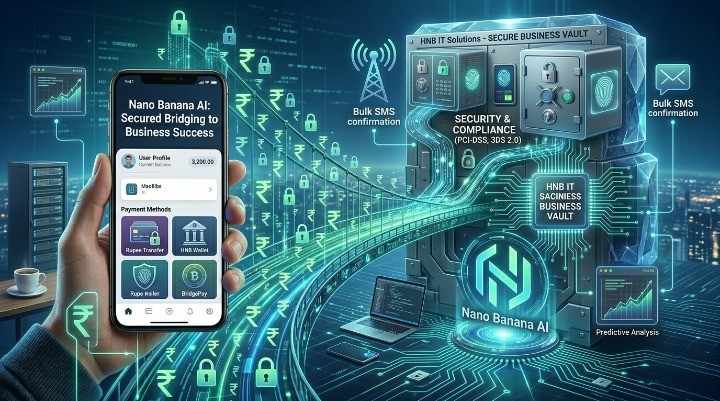
A payment gateway is like a digital bridge between your customer’s bank and your business account. It securely transfers money, verifies details, and sends confirmation.
A custom payment gateway means you build your own system instead of using PayPal, Stripe, or Paytm. You control the fees, the user interface, and the security layers.
Think of it like owning your own ATM vs using someone else’s.
Why Your Business Needs a Custom Payment Gateway in 2026
Still using third-party gateways? Here’s why you should switch to a custom solution:
1. Lower Transaction Costs
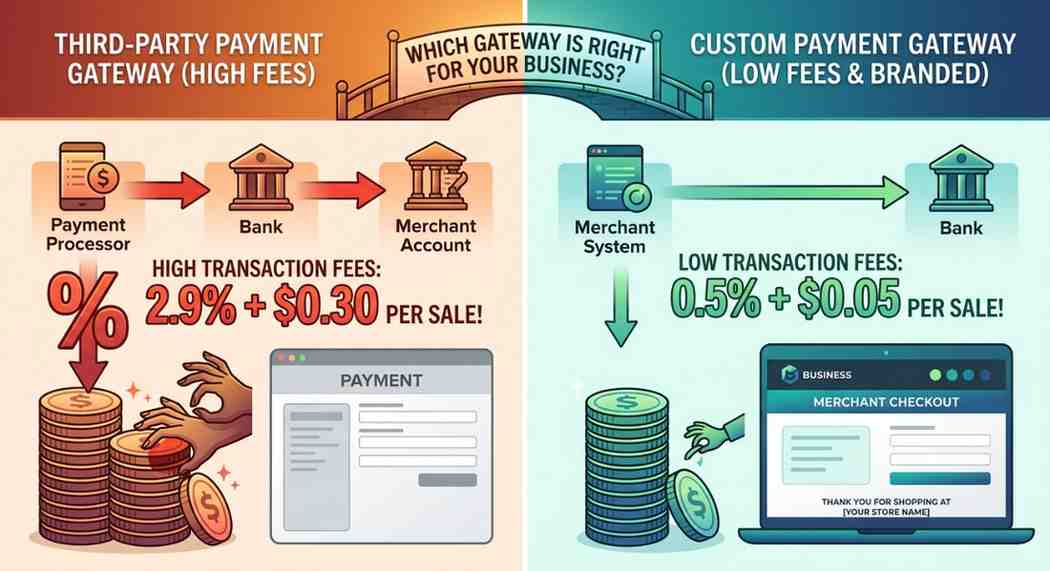
Third parties charge 2-3% per transaction. With your own gateway, you pay only bank charges (0.5-1%). On ₹10 lakh monthly sales, you save ₹20,000+ every month.
2. Full Data Control
Customer card details, UPI IDs, and transaction history stay on your secure servers. No data sharing with third parties.
3. Branded Checkout Experience
Your payment page looks like your website, not a random third-party page. This builds trust.
4. AI-Powered Fraud Detection
We add AI tools development features like real-time fraud scoring, unusual pattern detection, and auto-blocking.
5. Integration with Bulk SMS
After every payment, your customer gets an instant SMS confirmation using our SMS & bulk SMS services. This reduces chargebacks.
[Nano Banana AI Prompt]: Split screen comparison: left side showing third-party gateway with high fee percentage, right side showing custom gateway with low fees and branded checkout, infographic style
Must-Have Features in a Custom Payment Gateway (2026 Edition)
If you’re planning to develop a payment gateway, include these non-negotiable features:
| Feature | Why It Matters |
|---|---|
| PCI-DSS Compliance | Required for handling card data legally |
| Multi-currency Support | Accept USD, INR, EUR, etc. |
| UPI, Cards, NetBanking, Wallets | All payment modes in one place |
| Two-Factor Authentication (2FA) | Extra security layer |
| Recurring Billing | For subscriptions and EMI |
| AI Fraud Detection | Blocks suspicious transactions in real-time |
| Instant SMS Alerts | Via bulk SMS API |
| Webhook & API Support | Connects with your app or ERP |
| Refund & Dispute Management | Automated partial/full refunds |
| Dashboard & Analytics | See sales, success rates, and failures |
Our team at HNB IT Solutions includes all these features in every custom gateway we build.
Step-by-Step Process to Develop a Custom Payment Gateway
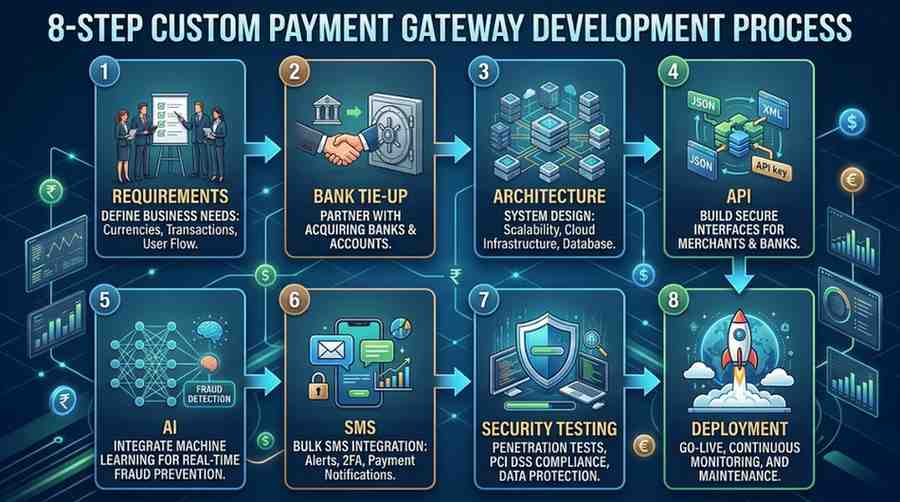
Here’s how we, as a leading app development company in Delhi, build custom payment gateways:
Step 1: Requirement Gathering
We ask: How many transactions per day? Which payment methods? Any AI needs? Compliance level?
Step 2: Bank & Partner Acquisitions
We help you connect with banks (HDFC, ICICI, SBI) and payment networks (RuPay, Visa, Mastercard).
Step 3: Architecture Design
We design a highly secure backend with encryption, tokenisation, and load balancing.
Step 4: API Development
We build REST APIs for your mobile app, web app, or POS system.
Step 5: AI Tools Integration
Add fraud detection, auto-retry logic, and smart routing.
Step 6: SMS & Notification Layer
Integrate bulk SMS services for OTP, transaction alerts, and reminders.
Step 7: Testing & Security Audit
We simulate attacks, test failover, and check PCI compliance.
Step 8: Deployment & Maintenance
Launch on your servers or cloud (AWS, Azure). We provide 24/7 monitoring.
We also offer software consultancy if you already have a team but need expert guidance.
Cost of Custom Payment Gateway Development in 2026
Prices vary based on features, transaction volume, and compliance level. Here’s a realistic estimate:
| Gateway Type | Estimated Cost (INR) | Time |
|---|---|---|
| Basic (UPI + Cards, 50k transactions/month) | ₹5,00,000 – ₹8,00,000 | 3-4 months |
| Advanced (with AI fraud + bulk SMS + multi-currency) | ₹10,00,000 – ₹18,00,000 | 5-7 months |
| Enterprise (bank-grade, high availability, custom dashboard) | ₹20,00,000+ | 6-9 months |
At HNB IT Solutions, we give you an exact quote after understanding your needs. No hidden fees.
Common Mistakes to Avoid When Building a Payment Gateway
I’ve seen fintech startups lose crores because of these errors:
Skipping PCI compliance – You can be fined or banned
No bulk SMS integration – Customers panic without OTP or receipt
Weak encryption – Hackers steal card data
No fallback system – Gateway goes down, business stops
Ignoring mobile optimisation – 70% payments happen on phones
We help you avoid all these. Our mobile app development and web development teams ensure your gateway works perfectly on every device.
How We at HNB IT Solutions Build Secure Gateways
We are HNB IT Solutions – a leading software development company in Delhi. We make All type Softwer & apps. Our specialities include:
✅ AI Tools Development – Fraud detection, smart routing
✅ Mobile App Development – iOS & Android SDKs for your gateway
✅ Web App Development – Merchant dashboards, admin panels
✅ Payment Gateway Services – Custom or third-party integration
✅ SMS & Bulk SMS Services – OTP, alerts, marketing
✅ Digital Marketing Services – Promote your new gateway
✅ Software Consultancy – Roadmap & architecture help
✅ App domain name + SEO Friendly Website – Because your gateway needs a website too
Our gateways are highly secure, fast, and used by businesses across India.

Future Trends in Payment Gateway Software (2026 & Beyond)
Voice Payments – Pay via Alexa, Google Assistant
Biometric Authentication – Fingerprint & face for high-value transactions
Blockchain Settlements – Instant, low-cost transfers
WhatsApp Payments – Pay within chat
AI Predictive Analytics – Know which transactions will fail before they happen
If you want to lead, start building your custom gateway today.
Final Words
A custom payment gateway is not just a cost-saving tool—it’s a strategic asset. You control the user experience, the data, and the future features. In 2026, businesses that own their payment infrastructure will win.
At HNB IT Solutions, we don’t just write code. We build secure, scalable, and smart payment ecosystems.
Ready to build your own payment gateway?
Visit: https://hnbitsolutions.com/
Call us or drop an email for a free consultation.
Disclaimer: Pricing and timelines are estimates. Actual costs depend on your specific requirements.